-
Design and Creative
- Brand Identity Design
- Logo Design
- Singing
- Acting
- Voice Talent
- Music Performance
- Visual Effects
- 2D Animation
- Video Production
- Photography
- AI Video Generation & Editing
- Motion Graphics
- Videography
- 3D Animation
- Presentation Design
- Art Direction
- AI Image Generation & Editing
- Packaging Design
- Creative Direction
- Image Editing
- Editorial Design
- Graphic Design
- Cartoons & Comics
- Pattern Design
- Fine Art
- Portraits & Caricatures
- Illustration
- Songwriting & Music Composition
- Audio Production
- Product & Industrial Design
- Jewelry Design
- Fashion Design
- NFT Art
- AR/VR Design
- Game Art
- Product Photography
- Local Photography
- Video Editing
- Music Production
- Audio Editing
- AI Speech & Audio Generation
- IT & Networking
- Customer Service
-
Admin Support
- Personal Virtual Assistance
- Executive Virtual Assistance
- Legal Virtual Assistance
- Ecommerce Management
- Medical Virtual Assistance
- General Virtual Assistance
- Data Entry
- Manual Transcription
- Digital Project Management
- Construction & Engineering Project Management
- Business Project Management
- Supply Chain & Logistics Project Management
- Development & IT Project Management
- Healthcare Project Management
- Quantitative Research
- General Research Services
- Product Reviews
- Web & Software Product Research
- Market Research
- Qualitative Research
-
Engineering & Architecture
- Structural Engineering
- Building Information Modeling
- Civil Engineering
- 3D Modeling & Rendering
- CAD
- Landscape Architecture
- Architectural Design
- Interior Design
- Trade Show Design
- Energy Engineering
- Mechanical Engineering
- Chemical & Process Engineering
- Electronic Engineering
- Electrical Engineering
- STEM Tutoring
- Physics
- Mathematics
- Biology
- Chemistry
- Logistics & Supply Chain Management
- Sourcing & Procurement
- Data Science & Analytics
- Sales & Marketing
-
Writing
- Proofreading
- Copy Editing
- Sales Copywriting
- Marketing Copywriting
- Ad & Email Copywriting
- Medical Writing
- Grant Writing
- Business & Proposal Writing
- Legal Writing
- Resume & Cover Letter Writing
- Technical Writing
- Academic & Research Writing
- Creative Writing
- Web & UX Writing
- AI Content Writing
- Ghostwriting
- Writing Tutoring
- Article & Blog Writing
- Script writing
- Scriptwriting
-
Web, Mobile & Software Dev
- Ecommerce Website Development
- Desktop Software Development
- Scripting & Automation
- Manual Testing
- Automation Testing
- AI Chatbot Development
- Prototyping
- Mobile Design
- Web Design
- UX/UI Design
- Mobile App Development
- Mobile Game Development
- Crypto Coins & Tokens
- Blockchain & NFT Development
- Crypto Wallet Development
- Scrum Leadership
- Product Management
- Firmware Development
- Emerging Tech
- AR/VR Development
- Coding Tutoring
- Database Development
- Back-End Development
- Front-End Development
- Full Stack Development
- CMS Development
- Video Game Development
- AI Integration
- DevOps & Cloud
- Accounting & Consulting
- Legal
- Translation
Blog Details
- Home
- Blog Details
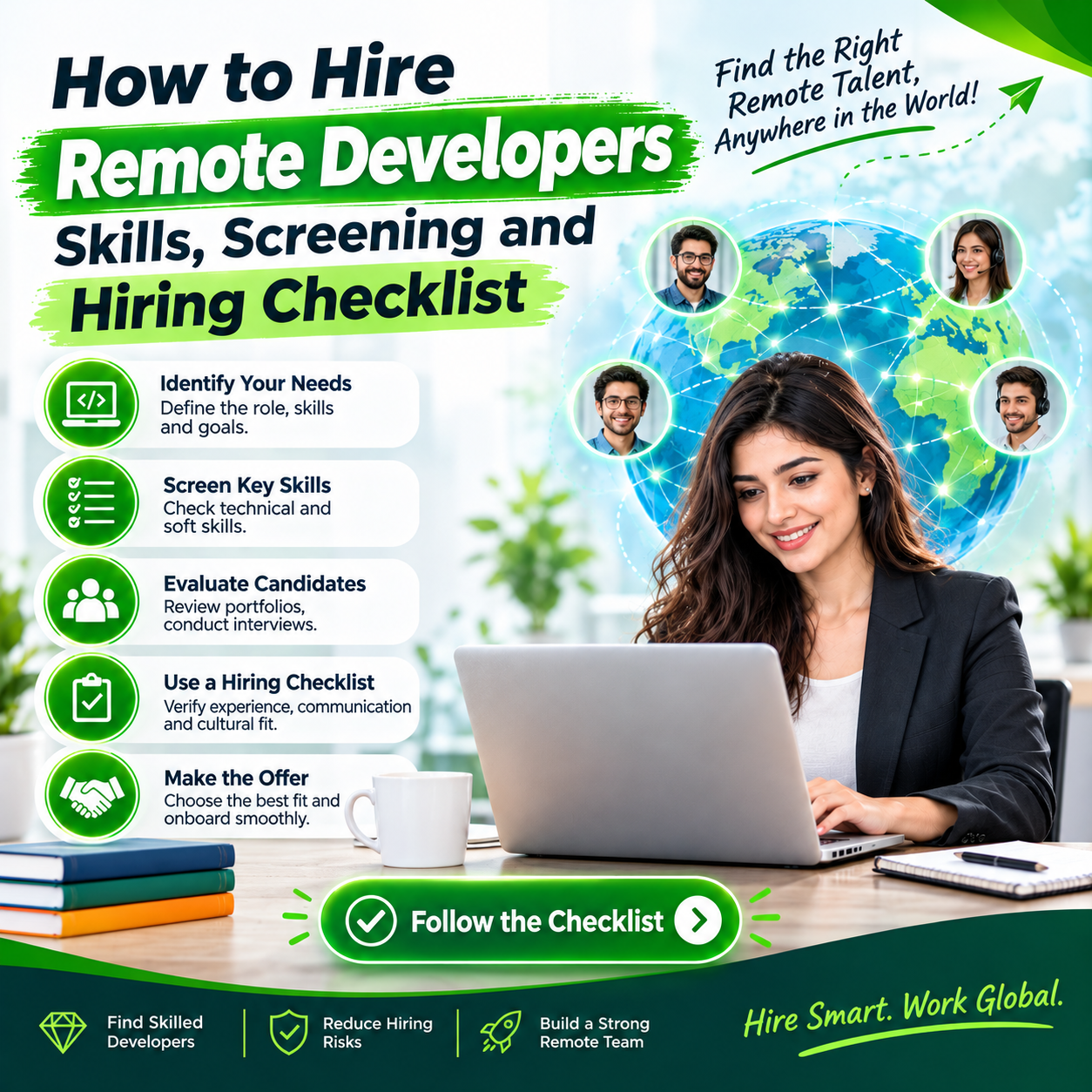
How to Hire Remote Developers - Skills, Screening and Hiring Checklist
Need a developer who can build your website, application, or software without the limitations of office-based hiring? Finding the right technical professional is easier when you know what skills to look for and how to evaluate candidates.
Hiring remote developers requires checking technical expertise, project experience, communication skills, problem-solving ability, and reliability before making a final decision.
This guide explains developer skills, candidate screening, technical interviews, hiring mistakes, and a practical checklist to help you choose the right professional.
Why Businesses Hire Remote Developers
Remote hiring gives businesses access to professionals beyond their local talent market. Companies can find developers for specific technologies, project requirements, and working arrangements.
Businesses often hire remote developers for:
- Website and application development
- Software upgrades and maintenance
- API integration and automation
- Mobile app development
- Technical support and bug fixing
- Long-term product development
Remote teams can also help businesses manage workloads without expanding their physical office.
1. Access to Specialized Technical Skills
A project may require a particular programming language, framework, or technical experience. Remote hiring makes it easier to find professionals with the right specialization.
2. Flexible Hiring Options
Businesses can hire developers for short-term tasks, ongoing projects, or long-term positions. This flexibility allows companies to select an arrangement that matches their workload and budget.
Which Skills Should You Check Before Hiring a Remote Developer?
A developer's job title does not always explain their actual capabilities. Review their technical knowledge and how they apply it to real projects.
1. Programming Languages and Frameworks
Check whether the candidate has practical experience with the technologies your project needs.
Common technical skills include:
- JavaScript and TypeScript
- Python and PHP
- React and Angular
- Node.js and Laravel
- HTML and CSS
- SQL and database management
For specialized projects, also review experience with APIs, cloud platforms, mobile frameworks, or automation tools.
2. Problem-Solving and Debugging
Strong developers do more than write code. They investigate errors, identify their causes, and find solutions without creating unnecessary complications. Ask candidates to explain a technical problem they solved, the steps they followed, and the results of their work.
3. Version Control and Development Workflow
Professional development often involves collaboration. Candidates should understand Git, code reviews, documentation, testing, and project management workflows. These skills help remote teams share updates and maintain organized development processes.
4. Communication and Independent Working
Remote developers need to explain progress, ask relevant questions, and report blockers clearly. Look for professionals who can manage tasks independently while remaining responsive when collaboration is needed.
Where to Find and Hire Remote Developers
Businesses can use different hiring channels to discover software professionals. The best option depends on the project size, urgency, budget, and required experience.
1. Freelance Platforms
Freelance marketplaces allow clients to publish projects, receive proposals, compare professionals, and discuss requirements.
RightFreelancer provides categories for different development services, helping clients explore professionals according to their project needs.
Explore Back-End Development to find developers for server-side systems, database connections, APIs, and application logic.
2. Developer Communities and Professional Networks
Technical communities, networking groups, professional profiles, and open-source projects can help you identify developers with relevant experience. Review their contributions and project involvement rather than relying only on profile descriptions.
3. Referrals and Talent Networks
Recommendations from colleagues or industry contacts can provide useful starting points. However, referred candidates should still complete the same skills evaluation and interview process.
How to Screen Remote Developers Before Hiring
A structured screening process makes candidate comparisons more consistent and reduces the risk of selecting someone who does not meet your requirements.
1. Review the Developer's Portfolio
Look for completed projects that are similar to your own. Review websites, applications, code samples, technical contributions, and project descriptions where available. Ask candidates to explain their specific role in projects completed with other team members.
2. Check Relevant Work Experience
Focus on experience that matches your project. A developer who has built similar features, handled comparable databases, or worked with your technology stack may understand your requirements more quickly.
3. Evaluate Technical Knowledge
Use questions related to the actual job rather than testing unrelated concepts. For example, a backend candidate may be asked about API design, database queries, authentication, security, and performance troubleshooting.
4. Use a Practical Coding Assessment
A short, relevant task can reveal how a developer approaches real work.
Consider assessing:
- Code organization
- Problem-solving
- Testing
- Error handling
- Readability
- Technical decision-making
Avoid lengthy unpaid assignments. A focused assessment or paid trial project is generally more respectful of candidates' time.
5. Conduct a Video Interview
A video interview allows you to discuss previous work and understand how candidates communicate. Ask them to explain their decisions, respond to hypothetical challenges, and describe how they handle unexpected technical problems.
6. Check References and Availability
When appropriate, contact previous clients or employers to verify relevant experience. Also confirm availability, working hours, project commitment, communication expectations, and delivery timelines.
How to Write an Effective Remote Developer Job Post
A clear job description helps attract relevant applicants and reduces confusion during screening.
Include these details:
- Project overview and objectives
- Developer specialization
- Required programming languages
- Experience level
- Project duration
- Budget or payment structure
- Time-zone requirements
- Expected deliverables
- Hiring and assessment process
For example, a company hiring a React developer should explain whether the role involves building new pages, improving existing interfaces, integrating APIs, or maintaining an application.
You can explore Front-End Development services when your project focuses on user interfaces, responsive layouts, and website functionality.
Remote Developer Hiring Checklist
Use this checklist before finalizing a candidate.
Before Screening
- Define the project scope and objectives.
- Identify the required programming languages.
- Set the budget and timeline.
- Separate essential skills from optional skills.
- Prepare a clear job description.
During Screening
- Review portfolio and previous work.
- Check relevant technical experience.
- Evaluate problem-solving ability.
- Conduct a technical interview.
- Assess communication and availability.
- Verify references when appropriate.
Before Hiring
- Confirm project deliverables.
- Agree on payment and milestones.
- Discuss revisions and maintenance.
- Establish communication expectations.
- Confirm ownership of code and project files.
- Arrange secure access to project resources.
Common Mistakes When Hiring Remote Developers
Hiring decisions can become difficult when businesses overlook important details.
1. Choosing Only the Lowest Price
Low pricing does not automatically mean poor quality, but selecting a developer without reviewing skills can result in delays, technical problems, or additional expenses.
2. Ignoring Project-Specific Experience
A candidate may have several years of experience but limited knowledge of your required technology. Match skills with project needs.
3. Skipping Technical Assessment
A strong CV does not guarantee practical ability. Use relevant questions and realistic assessments to confirm expertise.
4. Unclear Project Requirements
Incomplete instructions can create misunderstandings, unnecessary revisions, and missed deadlines. Define expectations before work begins.
How RightFreelancer Helps You Find Remote Developers
RightFreelancer allows clients to post projects, receive proposals, review freelancer profiles, compare candidates, and communicate with professionals before awarding work.
You can explore Full-Stack Development professionals for projects requiring both front-end and back-end capabilities.
Clients can also browse different skills, experience levels, project budgets, and available talent to help shortlist suitable candidates.
If your project requires mobile software, explore Mobile App Development to find professionals working on mobile applications and related development tasks.
Conclusion
Hiring the right remote developer starts with clear project requirements and a consistent screening process. Technical skills, relevant experience, communication, practical assessments, and professional reliability should all influence your decision.
Avoid choosing candidates based only on pricing or impressive profile descriptions. Evaluate their actual capabilities and agree on project expectations before work begins.
Explore remote development talent on RightFreelancer, compare suitable professionals, and find the skills your next project needs.
Frequently Asked Questions
Q1. How do I hire remote developers for my project?
Define your project requirements, identify the required technical skills, review developer portfolios, conduct interviews, and evaluate candidates through relevant technical assessments.
Q2. What skills should I look for in a remote developer?
Look for programming knowledge, problem-solving, debugging, database management, version control, communication, and experience with your project's required technologies.
Q3. Where can I hire remote software developers?
You can hire remote software developers through freelance marketplaces, professional networks, developer communities, referrals, and online hiring platforms such as RightFreelancer.
Q4. How do I screen remote developers before hiring?
Review their portfolios, check previous experience, conduct technical interviews, evaluate coding skills, and confirm their availability and communication practices.
Q5. What is the best way to test a remote developer's technical skills?
Use a short, project-related coding task, practical assessment, code review, or technical discussion to evaluate problem-solving, code quality, and technical understanding.
Q6. How much does it rates to hire a remote developer?
Remote developer costs depend on experience, technical specialization, project complexity, location, and hiring arrangement. Compare proposals and discuss deliverables before agreeing on a budget.
Q7. Should I hire a freelance developer or a full-time remote developer?
Freelancers are suitable for specific projects, temporary requirements, and flexible workloads. Full-time remote developers are often better for continuous development, long-term product maintenance, and ongoing team responsibilities.
Q8. What questions should I ask during a remote developer interview?
Ask about previous projects, preferred technologies, debugging methods, development workflows, project challenges, communication habits, and how they manage deadlines.
Q9. How can I avoid mistakes when hiring remote developers?
Write a clear job description, verify relevant experience, assess technical skills, agree on deliverables, establish payment milestones, and communicate project expectations before hiring.
Q10. How can RightFreelancer help me hire remote developers?
RightFreelancer allows clients to explore developer categories, post projects, review freelancer profiles, compare proposals, and find professionals with relevant technical skills for their projects.